Everyday
Americans experience the horror of fire. But most people don’t
understand fire. Only when we know the true nature of fire can
we prepare our families and ourselves. Each year more than 4,000
American’s die and approximately 25,000 are injured in
fires many of which could have been prevented. Nearly 1,000
lives are lost to fires that originated in the bedroom and about
100 firefighters are killed in the line of duty each year. Each
year in the United States fires kill more American’s than
all natural disasters combined. About 80% of these deaths occur
in residences and it is estimated that over 39% of residential
fires and 52% of residential fatalities occur in homes with
no smoke alarms. A working smoke alarm dramatically increases
a person’s chance of survival. Residential sprinklers
have also become more cost effective to install in homes although
few homes still have them. During the winter months, the potential
for fires increase because of the use of Christmas trees, heating
appliances such as the furnace, space heaters, and fireplaces
as well as the increased use of lighting. House fires in the
U.S. that are started by candles are at a 20-year high. Children
playing with fire set over 100,000 fires annually and over 30%
of those fires kill the children who started them. This is over
800 children killed each year by the fires they set playing.
Studies of electrical fires in homes show that many problems
are associated with improper installation of electrical devices
by do-it-yourselfers. Common errors that can lead to fires include
the use of improperly rated devices such as switches or receptacles
and loose connections at these devices. A house fire is reported
in the United States every 90 seconds this is an average of
1.9 million fires reported each year and someone dies in a house
fire every two and one-half hours.

FIRE
IS FAST
There
is little time!
In
less than 30 seconds a small flame can get completely
out of control and turn into a major fire. It only takes
minutes for thick black smoke to fill a house. In minutes,
a house can be engulfed in flames. Most fires occur in
the home when people are asleep. If you wake up to a fire,
you won’t have time to grab valuables because fire
spreads to quickly and the smoke is too thick. There is
only time to escape.
|
|
|
FIRE
IS HOT
Heat
is more threatening than flames!
A
fire’s heat alone can kill. Room temperatures in
a fire can be 100 degrees at floor level and rise to 600
degrees at eye level. Inhaling this supper hot air will
scorch your lungs. This heat can melt clothes to your
skin. In five minutes a room can get so hot that everything
in it ignites at once: this is called flashover.
|
FIRE
IS DARK
Fire
isn’t bright it’s pitch black. Fire starts
bright, but quickly produces black smoke and complete
darkness. If you wake up to a fire you may be blinded,
disoriented and unable to find you way around the home
you have lived in for years.
|
|
|
FIRE
IS DEADLY
Smoke
and toxic gases kill more people than flames do!
Fire
uses up the oxygen you need and produces smoke and poisonous
gases that kill. Breathing even small amounts of smoke
and toxic gases can make you drowsy, disoriented and short
of breath. The odorless, colorless fumes can lull you
into a deep sleep before the flames reach your door. You
may not wake up in time to escape.
|
CAUSES
OF FIRES AND FIRE DEATHS
Cooking
is the leading cause of home fires in the U.S. It is also
the leading cause of home fire injuries. Cooking fires
often result from unattended cooking and human error,
rather than mechanical failure of stoves or ovens. Careless
smoking is the leading cause of fire deaths. Smoke alarms
and smolder-resistant bedding and upholstered furniture
are significant fire deterrents. Arson is both the second
leading cause of residential fires and residential fire
deaths. In commercial properties, arson is the major cause
of death, injuries and dollar loss. Heating is the third
leading cause of residential fires. Heating fires are
a larger problem in single-family homes than in apartments.
Unlike apartments, the heating systems in single-family
homes are often not professionally maintained.
|
|
|
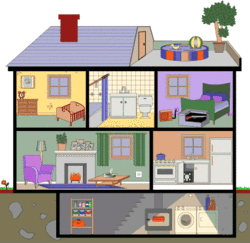
WHERE
FIRES OCCUR
Fires
in single family dwellings most often occur in the:
1. Kitchen (25.5%)
2. Bedroom (13.7%)
3. Living Room (8.6%)
4. Chimney (8.2%)
5. Laundry area (5%)
Apartment
fires most often occur in the:
1. Kitchen (48.5%)
2. Bedroom (13.4%)
3. Living Room (6.4%)
4. Laundry area (3.5%)
5. Bathroom (2.4%)
|
WHO
IS AT RISK
Senior
citizens age 65 and older and children under the age of 5 have
the greatest risk of fire death. The fire death risk among seniors
over 65 is more than double; over the age 75 triple; over the
age 85, 3 and on half times the average population. Children
under the age of 10 accounted for an estimated 22.2 % of all
fire deaths. Men die or are injured in fires almost twice as
often as women. African Americans and American Indians have
significantly higher death rates per capita than the national
average. Although African Americans comprise an estimated 13%
of the population, they account for 26 % of the fire deaths.
NOTE:
IN THE ESTIMATED TIME IT TOOK YOU TO READ THIS PAGE THERE HAS
BEEN AN ESTIMATED 3 TO 4 STRUCTURE FIRES REPORTED SOMEWHERE IN
THE UNITED STATES.
|
|